Feeds:
Posts
Comments

Photo: Silicon Ranch.
Cattle have been marked for an animal behavior study, showing each cow’s interaction with the solar equipment on Silicon Ranch’s Christiana Solar Farm.

If the cows in the picture above look a little strange, it’s because they are part of a study to see if they can coexist with solar panels, as sheep have already done successfully.

Dan Gearino writes at Inside Climate News, “It is unusual to have a utility-scale solar array in Kentucky, and even more unusual that the grounds crew here is a live-in flock of more than a thousand sheep. …

“The property is a farm and a power plant, and the developer, Silicon Ranch, is using this site to test how to maximize the income from both businesses. The work is part of an effort by solar companies and farmers searching for ways to efficiently utilize the hundreds of millions of acres in the United States used for livestock grazing..

“Nick de Vries, Silicon Ranch’s chief technology officer, walked along a row of panels, explaining that his company and others have largely figured out how to integrate sheep farming and solar. The next step is to replicate the process with cattle, he said. …

“The combination of solar and cattle could transform the renewable energy landscape, opening up vast stretches of land for solar development, contributing to a transition away from climate-warming fossil fuels.

“It also would address concerns about solar encroaching on food production and agribusiness, de Vries said. That’s an important factor in Kentucky, which ranks in the bottom 10 in the country in utility-scale solar installed capacity. …

Inside Climate News visited this farm to discuss [Silicon Ranch’s] CattleTracker and check on the progress of agrivoltaics — the integration of solar and agriculture — at a time when the [federal] administration is eliminating renewable energy subsidies and cutting budgets for research grants.

“Developing solar with cattle presents a major opportunity to expand solar energy, given the vast size of the U.S. beef industry, but it also poses some significant challenges.

“ ‘They’re very large animals,’ de Vries said. ‘They scrape on things. They like to rub.’ …

“He views the challenges with cattle as surmountable. He stepped to a nearby row of panels and pointed out which parts can withstand contact with a cow, and which are vulnerable.

“The main idea behind CattleTracker is that panels are vulnerable when turned at close to vertical angles because they are then low enough for cows to bump into them. The solution is to adjust the tracker system — the machines that tilt the panels throughout the day to capture the sun — so that the panels stay at close to a horizontal angle when cows are present.

“In a typical ranch, workers move the herd to a different part of a property every few days so the animals can have fresh grass and avoid manure pileup. Solar panels can operate with normal tracking most of the time when cows are away, and with limited tracking when cows are present. The system has controls to set the mode. …

“An inevitable part of the conversation is that animal agriculture and Americans’ meat-heavy diets are major contributors to climate change. Solar grazing is an attempt to marry a climate solution to a climate problem, with the expectation that the result is a net positive. …

“Silicon Ranch’s work on CattleTracker includes determining how to manage biodiversity and increase the land’s capacity to store carbon. …

“Solar grazing started with sheep, with some of the earliest U.S. examples coming online in the early 2010s. It’s a natural fit. Sheep are small enough that they’re unlikely to come into contact with panels. The panels provide shade and the animals eat grass, reducing the need for mowing.

“ ‘I just can’t even stress how awesome this opportunity is,’ said Daniel Bell, the farmer whose sheep live at the Silicon Ranch solar array in Lancaster. …

“In at least one way, the timing of Cattletracker’s rollout is not ideal. [The] administration is phasing out and cancelling many of the programs and grants that helped to subsidize renewable energy. …

“Silicon Ranch has benefitted from help in the form of government-funded research at universities and national labs to better understand the effects of solar grazing on soil and other environmental and animal health factors. But de Vries downplayed the harm of having less government support.

“ ‘I don’t think that there should be agrivoltaic subsidies,’ he said. ‘You should strive for a good business solution, and then find what’s going to make it replicable, not limited to grants.’ “

More at Inside Climate News, here.

Korean Court Cuisine

Photo: Netflix.
Lee Chae-min as the Joseon-era tyrant foodie king in Bon Appetit, Your Majesty.

If the novel Crying in H Mart didn’t get you hungering for Korean food, an unusual new series probably will.

Hanh Nguyen, executive editor at Salon, starts a review with a line from a 14th century palace cook.

” ‘How could a woman know how to prepare a royal meal?’ asks a palace cook in the Netflix series Bon Appetit, Your Majesty.

“Set five hundred years ago during Korea’s Joseon era, the hit period k-drama reveals how courtiers back then only deemed men skilled enough to craft meals worthy of royal consumption. The woman in question, Chef Yeon Ji-yeong (Im Yoon-ah), not only delivers on those high standards but exceeds them, wowing the King (Lee Chae-min) with dishes, ingredients and techniques that haven’t been seen before – literally. It turns out that Chef Yeon is a time-traveling French cuisine chef from the future.

Bon Appetit, Your Majesty delights in trotting out Yeon’s modern, European know-how, ranging from whipping up vibrant-hued macarons to maintaining meat’s juiciness through sous vide cooking. However, the limited series similarly introduces viewers – accustomed to kimbap, ramyeon or bulgogi – to unfamiliar historical dishes: Korean palace cuisine.

“Junwon Park, who’s training to become a Korean craftsman-level cook, [says] ‘I think it’s a culture. And the reason I say that is because, just like in the Bon Appetit, Your Majesty show, they used food, not just to eat, but often as a ritualistic event. They were trying to send a message.’

“Throughout the series, the palace tasks Chef Yeon with crafting dishes to convey various intangible themes – often with her own life or the country’s future on the line. When instructed to cook a meal ‘fit for a king,’ Yeon turns to venison because deer had symbolized kings, and the tongue is seen as a rare delicacy only he has the privilege to enjoy. Therefore, the thought that goes into the care and feeding of monarchs reaches beyond mere culinary execution but also encompasses ingenuity, knowledge and a sense of diplomacy (not to mention flattery).

“ ‘That is just like how it happened in the actual Korean palace,’ Park confirmed. ‘One king, King Yeongjo, actually made a dish called tangpyeong-chae. He made this dish as a cold salad that mixes ingredients of different colors, each color representing a political faction that the palace was divided into. So by serving this dish and announcing the policy of having a quota that his palace is going to hire from all the factions, he was announcing that he wants the palace to be run like that salad – that people from different factions are coming together to create one flavor. So it was not just a dish.’

“Despite her expertise in French cuisine, Chef Yeon also demonstrates a deep understanding of Korean royal cookery and wields her modern knowledge to innovate while still maintaining the integrity of the royal dish. To embody the idea of filial piety to appeal to the Grand Queen Dowager, Yeon creates doenjang-guk, a traditional soybean paste stew, but adds two special ingredients: spinach and clams. She reveals that the spinach – an ingredient not regularly used in cooking during that time period – is full of iron and therefore can help Her Highness, who has been feeling weaker lately.

” ‘Food and medicine share the same roots,’ she says, citing the yaksikdongwon philosophy. …

“The clams, however, are the stew’s secret weapon. Knowing the Queen Dowager has long sought a doenjang-guk that tastes like her late mother’s, Yeon realizes that clams would add that mystery umami that only people who were raised near the Seomjin River or Nakdong River would have accessed. Once the Queen Dowager tastes the soup, she’s transported back to childhood and tearfully declares, ‘The soup contains family. She has given me my family through this dish.’

“Later in the series, while prepping the Grand Queen Dowager’s 70th birthday banquet, Chef Yeon must deal with a major menu-planning curveball: the birthday girl has been advised to cut out meat from her diet. Yeon certainly doesn’t want to cook dishes that would threaten the Queen Dowager’s health, especially for an occasion honoring her longevity. But dishes comprising the Korean royal banquet, such as gujeolpan, often include meat. The name gujeolpan refers to nine ingredients on a plate, with eight colorful vegetables or proteins sliced thinly and arrayed around the edge of plate, much like a mouth-watering sundial. Small crepes sit in the dish’s center and provide a wrapper for the ingredients.

” ‘One of the most grand dishes in Korean Palace cuisine is actually what she prepares for the Grand Queen Dowager, which is gujeolpan,’ said Park. ‘Today it’s often used for weddings . . . it’s to show that “I am putting in so much effort” that I’m preparing each ingredient separately, laying it out separately in a beautiful presentation, and then we are putting it together to create one ssam, just like a bossam, or the way that we eat KBBQ in lettuce today. So it has a ritualistic meaning.

“ ‘But when [Chef Yeon] prepares it, she prepares a special version of the dish that uses something like Impossible meat, so like a soy-based meat, rather than a regular meat,’ he added. The faux meat impresses the courtiers, who note the effort required for the dish.

“ ‘Seeing all of you enjoy it so much, I couldn’t ask for more,’ says Yeon, before addressing the Grand Queen Dowager, ‘May you always be safe in good health.’ ”

More at Salon, here.

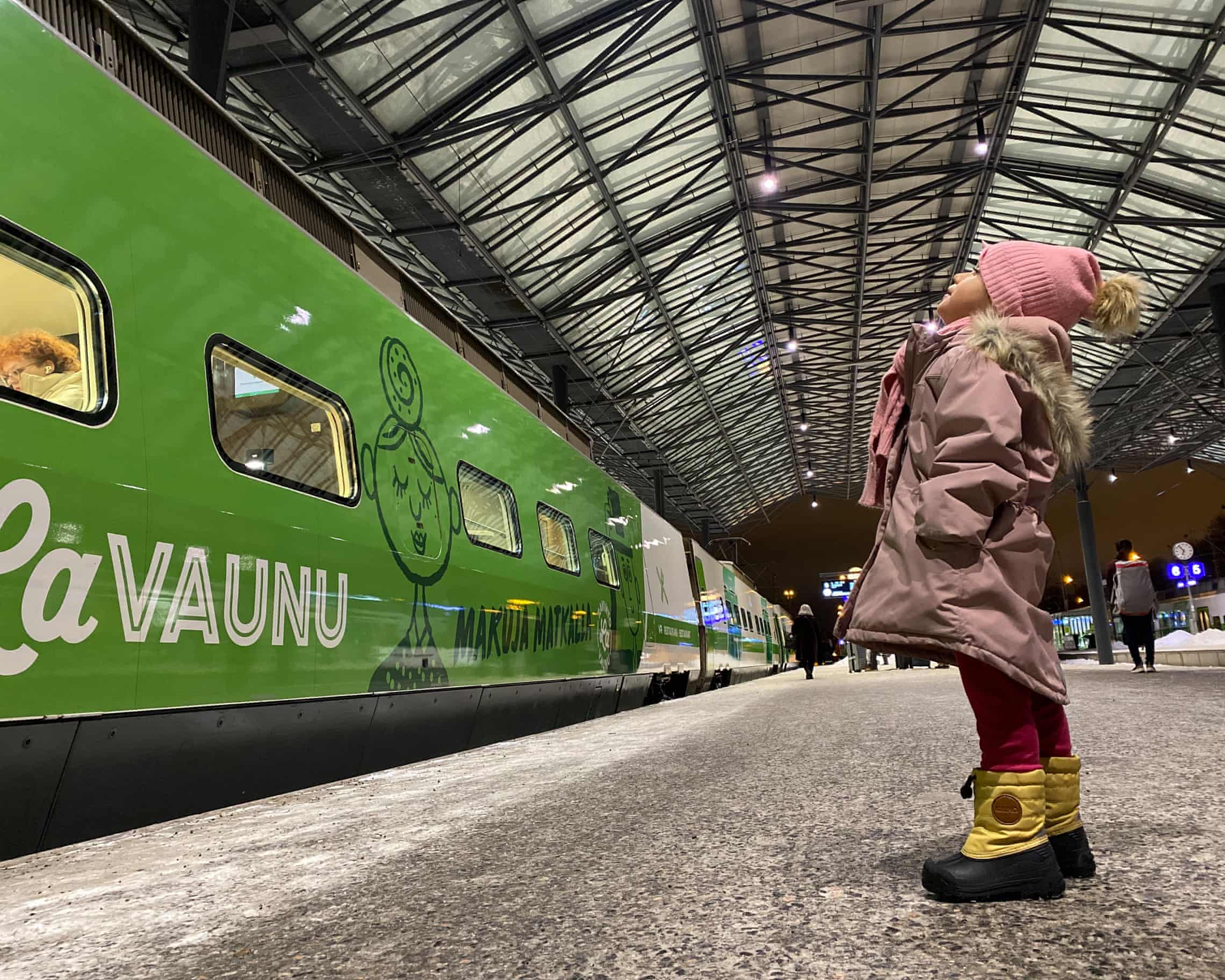
Photo: The Guardian.
The Santa Claus Express sleeper ready to leave Helsinki station on its journey north to Rovaniemi in Finnish Lapland.

When Suzanne and John were small, we somehow acquired a large poster of Finnish Lapland that purported to show the way to Santa’s headquarters. I had always assumed Santa lived at the North Pole, but I was beginning to learn about marketers with other ideas.

Natasha Geiling and Kayla Randall have the story at the Smithsonian magazine, starting with Alaska’s claim: “It wasn’t the actual North Pole. But the fact that it was over 1,700 miles from it, smack in the heart of interior Alaska, was a minor detail.

“When Bon and Bernice Davis came to Fairbanks in early April 1944, they weren’t looking for the North Pole. As they drove their rental car out of town, they had something else on their mind: finding 160 acres on which to make their homestead, something Alaska law allowed if they used the area for trading or manufacturing purposes. … In the summer, nearby streams might attract grayling fish and waterfowl, but in the snow-covered month of April, it was hard to see that potential. The area did boast one unique quality: consistently cooler temperatures, about seven to ten degrees colder than anywhere else in interior Alaska. …

“With its proximity to both the highway and Fairbanks, the Davis’ homestead soon attracted neighbors. … By the early 1950s, the homestead had also attracted the attention of the Dahl and Gaske Development Company, which purchased the land — nearly in its entirety — in February 1952. … If they could change the homestead’s name from ‘Davis’ to ‘North Pole,’ they reasoned, toy manufacturers would flock from far and wide. …

“Things didn’t go according to plan — even with its location right on Richardson Highway, the Alaskan North Pole was too remote to sustain manufacturing and shipping. However, part of Dahl and Gaske’s vision eventually did take shape at a local trading post, which became one of several places that claimed to be Santa Claus’ home during the 20th century. Now a tourist destination, the town of North Pole in Alaska calls itself the place ‘where the spirit of Christmas lives year round’ and boasts the Santa Claus House, a holiday-themed family business.

“The real Santa Claus — the historical figure upon which the legend is based — never lived anywhere near the North Pole. Saint Nicholas of Myra was a fourth-century bishop who lived and died far from the Arctic Circle, in what is now Turkey. Born into a wealthy family, Nicholas is said to have loved giving gifts. …

“Santa’s red robes and gift-giving habits were based on Saint Nicholas, but his chilly home base is the invention of cartoonist Thomas Nast, whose famous depiction of Santa Claus in a December 1866 issue of Harper’s Weekly set the precedent for our modern image of the jolly fellow. Before Nast, Santa had no specific home, though by the 1820s, he was already associated with reindeer and, by extension, the frigid climes in which those reindeer live.

“In 1866, Nast’s cartoon ‘Santa Claus and His Works‘ featured the words ‘Santaclaussville, N.P.’ alongside Santa performing the tasks people now associate him with, from making toys to making his list (and checking it twice, of course). The ‘N.P.’ stood for North Pole, where Nast had placed his workshop and residence. …

“In 1949, [Santa’s home] took physical form for the first time, 13 miles from Lake Placid, New York. While trying to keep his daughter occupied during a long drive, Julian Reiss, a New York businessman, reportedly told her a story about a baby bear who went on a great adventure to find Santa’s workshop at the North Pole. Reiss’ daughter demanded he make good on his story and take her to the workshop. …

“He teamed up with the artist Arto Monaco — who also helped design Disneyland in California — to create a physical version of Santa’s workshop on 25 wooded acres around Lake Placid. Santa’s Workshop in North Pole, New York, with its novel depiction of Santa’s magical workplace, brought visitors by the thousands. …

“Other businesspeople found success drawing tourists with the Santa Claus legend without borrowing the Arctic landmark. America’s first theme park, now Holiday World & Splashin’ Safari in Santa Claus, Indiana, actually operated as ‘Santa Claus Land‘ until 1984. …

“[Paul Brown — who today runs Alaska’s Santa Claus House along with his wife, Carissa] acknowledged that other places that claim equal ownership to Santa’s legend. ‘From a competitive standpoint, if you want to call it that, Rovaniemi, Finland, would be our biggest competition.’

“Rovaniemi — the administrative and commercial capital of Lapland, Finland’s northernmost province — wasn’t much of a tourist destination before Santa Claus came to town. Lapland had served as a sort of nebulous home base for Santa Claus in the European tradition ever since 1927, when a Finnish radio host proclaimed to know the secret of Santa’s hometown. He said it was in Korvatunturi, a mountainous region in Laplan. … Like the North Pole of Nast’s creation, however, Korvatunturi was real in theory but not necessarily to be visited.

“Santa’s home later moved over 225 miles south to Rovaniemi, thanks to an American visitor. During World War II [Rovaniemi burned] to the ground, leaving Lapland’s capital city in ruins. From those ashes, Rovaniemi rebuilt itself according to design plans that dictated its streets spread like reindeer antlers through the city. In 1950, on a tour of postwar reconstruction, former first lady Eleanor Roosevelt paid Rovaniemi a visit, allegedly saying she wanted to see Santa Claus while in the Arctic Circle. The town hastily constructed a cabin, and Santa’s Village in Rovaniemi was born. But tourism to Rovaniemi really took off in 1984. …

“From North Pole, Alaska, and North Pole, New York, to Rovaniemi, Finland, the mythology of where Santa Claus lives creates an economy. [But] Brown, for his part, sees himself as safeguarding the legend of Santa Claus. ‘We are very protective of the magic of Christmas and allowing kids to have that for as long as they can have it,’ Brown said. ‘Just like Santa is the embodiment of joy and goodwill, we think of ourselves as one of the embodiments of the spirit of Santa.’ ”

More at the Smithsonian, here. Check out a trip on Lapland’s Santa Express at the Guardian, here.

Merry Christmas

Peace to All!

Ordinary Kindnesses

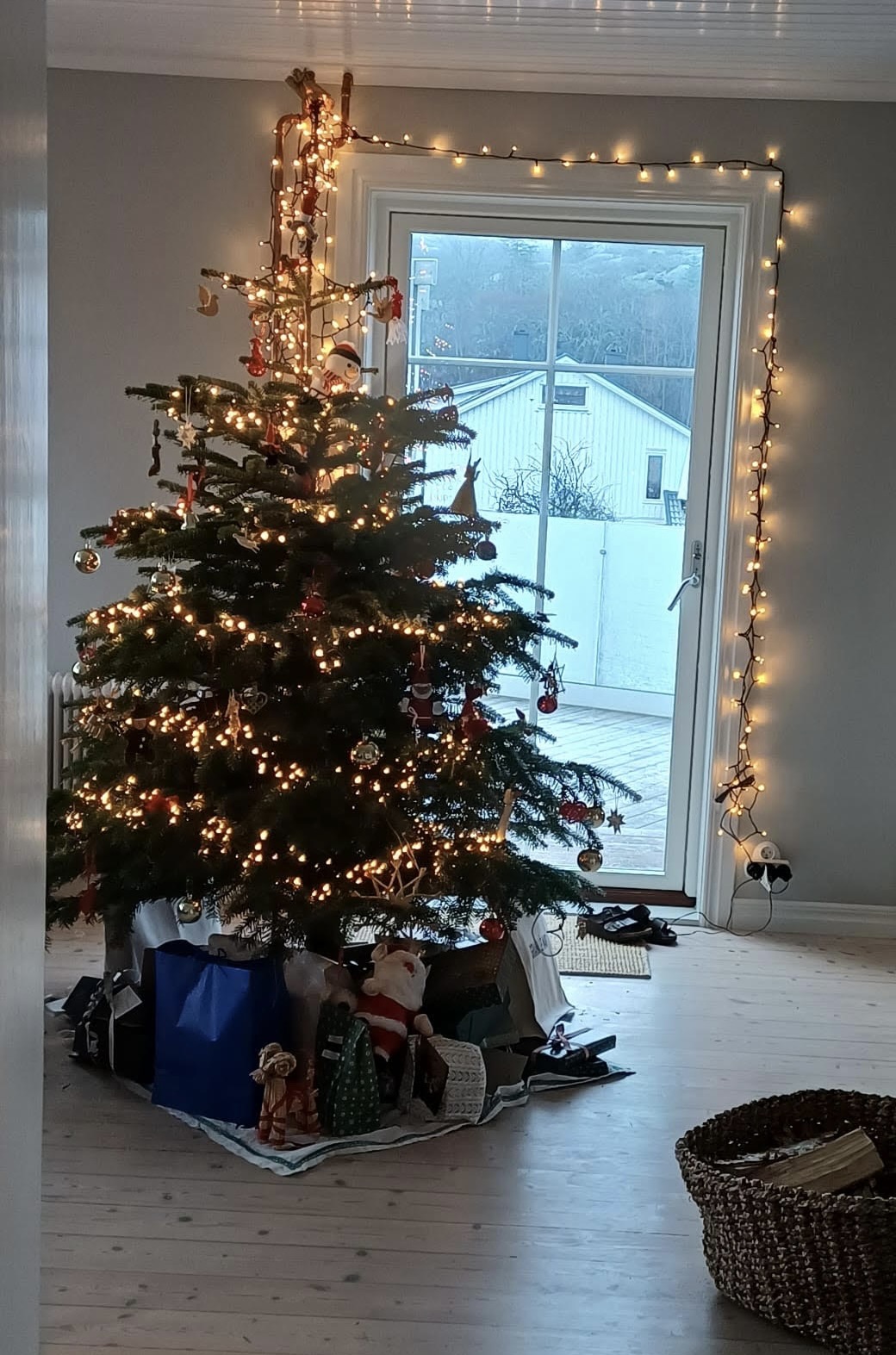
Photo: Stuga4.
Suzanne and family are celebrating Christmas in Hamburgön this year with Farmor and Swedish cousins.

I think you may know this poem about the many ways ordinary people show kindness, even to strangers. It’s a good one to reread at Christmas in our beleaguered world.

It’s called “Small Kindnesses” and was written by Danusha Laméris.

“I’ve been thinking about the way, when you walk
“down a crowded aisle, people pull in their legs
“to let you by. Or how strangers still say ‘bless you’
“when someone sneezes, a leftover
“from the Bubonic plague. ‘Don’t die,’ we are saying.
“And sometimes, when you spill lemons
“from your grocery bag, someone else will help you
“pick them up. Mostly, we don’t want to harm each other.
“We want to be handed our cup of coffee hot,
“and to say thank you to the person handing it. To smile
“at them and for them to smile back. For the waitress
“to call us honey when she sets down the bowl of clam chowder,
“and for the driver in the red pick-up truck to let us pass.
“We have so little of each other, now. So far
“from tribe and fire. Only these brief moments of exchange.
“What if they are the true dwelling of the holy, these
“fleeting temples we make together when we say, ‘Here,
” ‘have my seat,’ ‘Go ahead—you first,’ ‘I like your hat.’ “

Photos: John and Suzanne’s Mom.

Photo: Original Vienna SnowGlobe.
In the year 1900, Erwin Perzy I of Vienna created the very first snow globe. Unintentionally.

I’ve always liked stories of inventions that happened by accident. The currently ubiquitous Post-it Notes, for example. I think it takes special kinds of creative thinkers to realize they’ve on stumbled a good invention.

I recently learned that the popular snow globe was the offshoot of a medical project. Erik Trinidad writes about it at the Smithsonian.

“In the opening scene of the 1941 mystery Citizen Kane, the eponymous protagonist, played by Orson Welles, clenches a snow globe in his hand as he utters his last word: ‘rosebud.’ The glass-encased spherical diorama of a snowy scene was a mere novelty at the time, but the film, in part, gave rise to its popularity.

“Now, more than 80 years later, it’s hard to imagine the Christmas season without snow globes. A symbol of childhood nostalgia, the Austrian innovation has become beloved around the world.

“In September 2024, I toured the Original Viennese Snow Globe Factory and Museum in Vienna’s 17th district. Erwin Perzy III, spokesperson of the multigenerational family business, led me through the story of how his grandfather, Erwin Perzy I, invented the snow globe.

“ ‘He invented this by mistake, because he wanted to make something different,’ he told me. ‘The improvement of the electric light bulb was his [intention].’

“It was 1900 when Erwin Perzy I, a tradesman who built and repaired surgical instruments for local physicians in Vienna, was tasked with creating an inexpensive solution to amplify light in hospital operating rooms. Perzy, who always had a knack for experimenting in his workshop, found inspiration for his assignment in a tool used by local shoemakers: a glass globe filled with water to act as a magnifying glass. He positioned an Edison light bulb near a water-filled glass globe, and he added different reflective materials to the liquid that might help increase the illumination — including white particles that floated around before sinking like snow. …

“He had a friend who sold souvenirs to pilgrims at the Mariazell Basilica, a local religious site south of Vienna, for whom he made trinkets; he molded little pewter models of the church to be sold alongside candles and crosses. One day, an idea struck: to combine two of his handiworks together, by putting the miniature pewter church inside the wooden base of the glass globe filled with water and white wax particles — effectively creating the first snow globe. Perzy knew he had something special on his hands— not to mention marketable — and applied for a patent for ‘glass ball with snow effect.’ …

“ ‘Collectors agree that the first snow globe patent was issued to the Viennese Erwin Perzy,’ reports Anne Hilker in her thesis, ‘A Biography of the American Snow Globe: From Memory to Mass Production, From Souvenir to Sign,’ filed in the Smithsonian Libraries and Archives. But her report also cites appearances of snow globes that, while short-lived, predate Perzy’s patent. ‘The earliest snow globe for which both specific surviving contents and date can be established is that containing a miniature of the Eiffel Tower from the Paris [Exposition] of 1889.’ …

“Perzy started putting other models into glass spheres and selling them in markets around the city. By 1908, he had become known by many Austrians, including Emperor Franz Joseph, who praised Perzy for his ingenuity and gave him a special award as an Austrian toymaker. …

“Its trendiness waned after World War I. With the subsequent economic depression, snow globes were not a necessary purchase, and sales rapidly went into decline. The situation did not improve during World War II. However, when the war ended and soldiers returned home, starting families and creating the baby boom of the late 1940s and ’50s, a subsequent snow globe boom took hold. …

“Enter Erwin Perzy II, a motorbike and typewriter mechanic. … ‘My father’s idea was changing the pilgrim souvenir to a Christmas item,’ Perzy III told me. ‘He made a Christmas tree.’ Perzy II took three new models of snow globes—a Christmas tree, a snowman and Santa Claus—to the international toy fair in Nuremberg, Germany, in 1955.

“ ‘They bought our snow globes like it was something to eat!’ Perzy III gushed as he retold his father’s success story. ‘We supplied all the big stores, like Macy’s, Neiman Marcus, Saks Fifth Avenue, Bergdorf Goodman — all these big chains.’ “

More at the Smithsonian, here. Got any snow-globe memories? Please share them.

Photo: Zeena Bakery.
Ma’amoul is a traditional Middle Eastern cookie made by combining semolina flour with butter and milk, forming it into a dough, and filling it with nuts or dates. 

I love that in my extended family there are three religions. We have what are sometimes called the Children of Abraham because they share the Old Testament in some form: Jews, Muslims, and Christians.

Lillian Ali reports at the Smithsonian that they also share a shortbread cookie around the holidays. It’s called ma’amoul.

She writes, “Three days a week, Zeena Lattouf Joy rolls hundreds of balls made of semolina dough. She flattens them out; fills them with chopped walnuts, dates or pistachios; and uses a mold to shape them into decorated cookies called ma’amoul. …

“Ma’amoul is a traditional Middle Eastern cookie often enjoyed around Muslim, Christian and Jewish holidays, made by combining semolina flour with butter and milk, forming it into a dough, and filling it with nuts or dates. Some ma’amoul recipes use ghee, rather than traditional butter; others mix all-purpose flour with the semolina or add a small amount of sugar to the dough. Still others flavor the dough with rose water, orange blossom water or a marzipan-like spice called mahleb. Across all iterations, what sets ma’amoul apart from other shortbread cookies is the way they are shaped with a wooden mold with a decorative carving set inside, called a taabeh or a qaleb.

“ ‘I find it really meditative,”’says Lattouf Joy, of the process of rolling, flattening, stuffing and molding. ‘It allows me to just kind of zone out.’

“Lattouf Joy worked in behavioral psychology and negotiation for several years. ‘At some point along the way, I started to, you know, wonder: “What if I just baked bread?” ‘ she says. She ultimately quit her job, and, in late 2023, she founded Zeena Bakery.

“While many people think of knafeh or baklava when it comes to Arabic sweets, Lattouf Joy decided her ‘micro-bakery’ would specialize in ma’amoul, which she grew up baking with her Palestinian grandmother. …

“In January 2022, Lattouf Joy practiced iteration upon iteration of the recipe, trying to fine-tune it, adjusting quantities of flour and baking soda until she evoked her grandmother’s treasured cookie.

“Now, Zeena Bakery sells cookies at farmers markets in Brooklyn’s Fort Greene Park and Irving Square Park, as well as online, shipping thousands of them nationwide. She makes between 2,500 and 3,000 cookies each month, on average. Lattouf Joy says one idea motivating Zeena Bakery was to buy from farmers and try to center them in her business. She hopes that, as it continues to grow, the key stakeholders will stay the farmers she sources from and the employees.

“ ‘My goal is to center as many farmers as I can, whether they’re farmers in the Levant and Palestine or in New York,’ says Lattouf Joy.

‘My hope is to create an environment that is about kindness and love and care.’

“Before ma’amoul were treats served at special occasions, they were simple biscuits that fueled travelers. ‘ “Ma’amoul” is not really a fancy word,’ says Nawal Nasrallah, an Iraqi food writer and historian, known for translating medieval Middle Eastern recipes into English. It comes from the Arabic verb “amala,” which means “to do” or “to make.” ‘

“Ma’amoul can be traced back to an Egyptian cookie called kahk, Nasrallah explains. In the medieval era, ‘basketfuls’ of kahk could keep for weeks or months as travelers trekked on horseback or camelback. … Modern kahk, still enjoyed in Egypt, are nearly identical to ma’amoul, except that semolina flour is absent from the dough.

“The adoption of kahk, and later ma’amoul, as cookies used in religious celebration can be traced back to ancient Mesopotamia, Nasrallah says. Ancient Sumerians would celebrate the coming spring and the goddess Ishtar by preparing qullupu, also a dry cookie stuffed with dates.

“As time went on, the filled cookie, in the form of the ancient qullupu, the medieval kahk, and eventually ma’amoul and its Iraqi equivalent kleicha, stayed firm as staples of spring celebrations like Easter, Eid and Purim. …

“Ma’amoul even has relatives as far as China, where mooncakes are made with carved wooden molds similar to taabeh. In fact, Nasrallah says, the distinctive, circular patterns carved into the taabeh are moon-like, since Muslims follow the lunar calendar.

” ‘Names differ from region to region, from one era to another, but, basically, the food is the same, and its function is more or less the same: celebratory food for religious festivals,’ says Nasrallah. …

“In a blog post, Lattouf Joy writes that Zeena Bakery is a ‘love letter’ to her grandmother and ‘a love letter to all of our ancestors — yours and mine.’ ”

Check out the family recipe at the Smithsonian, here.

Photo: Shawn Miller/Library of Congress.
The Dalí Quartet, accompanied by Ricardo Morales on clarinet, performs during the Library of Congress’ Stradivari concert in Coolidge Auditorium in 2023.

I can see why, as National Public Radio suggests, the music program in today’s story has been staying under the radar. Under the radar is the place many good activities and people feel safest these days.

NPR’s Tom Huizenga reported recently on a little-known cultural venue in Washington DC.

“The year is 1925. The Great Gatsby is published, the jazz age is swinging, and on October 28th, a new concert hall opens at an unlikely spot — the Library of Congress, in Washington D.C. If only its cream-colored walls could talk. For 100 years, performers of all stripes have graced the Library stage, from classical music luminaries like Béla Bartók and Igor Stravinsky to Stevie WonderAudra McDonald and Max Roach. Today, it remains one of the capitol city’s most beautiful, best sounding and perhaps best kept secrets.

“The idea [came] from philanthropist Elizabeth Sprague Coolidge — and one bespoke piece of bipartisan legislation. ‘She was indefatigable and intrepid,’ says Anne McLean, senior producer for concerts at the Library, ‘a remarkable woman, six feet tall, a brilliant pianist.’ …

“Coolidge was born into a wealthy Chicago family in 1864. She studied music, traveled abroad, married a Harvard-trained orthopedic surgeon and, in 1924, came to Washington to establish a foothold in the nation’s capitol. She approached Carl Engel, the Library’s music chief, about the possibility of adding a small concert hall to the Library’s voluptuous — and voluminous — Thomas Jefferson building. …

“Eager to get started, Coolidge wrote a check for $60,000 to the Librarian of Congress, Herbert Putnam, on Nov. 12, 1924. And yet there was no legal mechanism in place for a civilian to make such a monetary gift to the U.S. government. Congress worked quickly, taking only a little over a month to pass a bill allowing such a contribution.

“It took less than six months to build the hall itself — the intimate, 485-seat Coolidge Auditorium, with its warm precise acoustics. ‘There are a lot of secrets to it,’ McLean says. ‘The back wall of the auditorium is slightly shaved to be concave and extremely responsive to string sound. Underneath the stage is hollow. But that hollowness is a factor, as is the cork floor, which was very unusual for its time.’ McLean says the sound blossoms in the hall. …

“The most famous [Coolidge] commission became one of America’s most iconic pieces of music. Aaron Copland‘s ballet Appalachian Spring, written for dancer and choreographer Martha Graham, received its world premiere at Coolidge Auditorium on Oct. 30, 1944. …

“And the commissions keep coming, thanks in part to generous women who followed in Coolidge’s philanthropic footsteps. Composers commissioned for the 100th anniversary include MacArthur fellows Tyshawn Sorey and Vijay Iyer, plus Pulitzer winner Raven Chacon, George Benjamin and the electronic artist Jlin. Pulitzer-winning composer Tania León had her own world premiere earlier in this 100th anniversary season. Para Violin y Piano was commissioned by the Library’s Leonora Jackson McKim Fund. …

“Situated inside the Library of Congress, Coolidge Auditorium benefits from the Library’s substantial acquisitions. In the mid-1930s, another philanthropist, Gertrude Clarke Whittall, gave the Library a set of rare Stradivarius instruments. …

” ‘When they were first acquired, there wasn’t a resident ensemble. And the concept was, “How do we keep them in great shape?” So they were occasionally hiring musicians to play them for $2.50 an hour,’ McLean says with a laugh. …

“These days, the Strads can be played by any string quartet booked for a concert at the Library. But McLean says there’s a catch: The musicians need to show up a couple days early to learn how to control them.

‘The secret of the [Strads] is that they are like racehorses, they’re thoroughbreds, and they can get away from you if you don’t have a chance to get used to them.’

“Cellist Daniel McDonough and his bandmates in the Jupiter String Quartet got used to them when they played the Strads at the Library earlier this year. I asked McDonough if playing one of the instruments was anything like finding yourself behind the wheel of a Ferrari.

” ‘Yes, the automotive analogy is a good one,’ he says. ‘Sometimes I say it has a fifth gear. These instruments, because they’ve been played for hundreds of years and because they’ve aged and grown into themselves so beautifully, have a kind of ringing tone that I think no other instrument’ has.”

More at NPR, here. Nice photos. No firewall.

Photo: Andrew Harnick/AP file photo.
Mellon Foundation president Elizabeth Alexander is one of the people behind a new fund for the literary arts.

Among the many worthy causes clamoring for our attention at this time of year and in this political climate are those that support the First Amendment, including freedom of the press.

Where I live, we have a nonprofit local newspaper that is sent free to every post box. it was launched with funds from donors and grants and now has the enthusiastic support of all sorts of local advertisers.

For national and international news, I subscribe to the Guardian and the Christian Science Monitor, which are independent of the kind of corporate pressure that contaminates many large television networks and newspapers. Who owns news purveyors really matters. And I believe that ordinary people can help a lot.

Another First Amendment realm that philanthropists have realized need support involves the literary arts — the freedom to write poetry, novels, and other kinds of high-quality books. That’s why a new fund has been started.

HILLEL ITALIE writes at the Associated Press, “Citing a chronic shortage of financial backing for independent publishers and nonprofits dedicated to writing and reading, a coalition of seven charitable foundations has established a Literary Arts Fund that will distribute a minimum of $50 million over the next five years.

“The idea for the fund was initiated by the Andrew W. Mellon Foundation, the country’s largest philanthropic supporter of the arts. Mellon President Elizabeth Alexander cited literature as a vital source of expression.

“ ‘Novelists, poets, and all manner of creative writers have shaped and driven our collective discourse and capacity for invention since the nation’s founding,’ Alexander, an acclaimed poet who joined Mellon in 2018, said in a statement. ‘American philanthropy can and must play a bigger role in strengthening the financial infrastructure of the literary organizations and nonprofits that serve these literary artists.’

“The other participants are the Ford Foundation, Hawthornden Foundation, Lannan Foundation, John D. and Catherine T. MacArthur Foundation, the Poetry Foundation and an anonymous foundation. The project will be overseen by Jennifer Benka, whose previous experience includes serving as executive director of the Academy of American Poets. …

“During a telephone interview with the Associated Press, Alexander emphasized that the literary fund had been in the works well before the National Endowment of the Arts and National Endowment of the Humanities drastically cut back their support this year for virtually every art form. She referred to a 2023 study from the research organization Candid that found literary organizations and individuals were receiving less than 2% of some $5 billion in arts grants awarded in the U.S. … Alexander said support will likely extend across a wide range of recipients, from poetry festivals to writer residencies to small publishers. …

Percival Everett, the Pulitzer Prize-winning novelist, said in a statement that ‘without nonprofit publishers American letters would have stalled long ago.’ Everett himself was published for decades by an independent press, Graywolf, before moving to Penguin Random House and breaking through commercially with James, which received the Pulitzer in 2024.”

More at AP, here. Please let me know if you have experience with nonprofit publishers.

The Red Crab Migration

Photo: Parks Australia via AP.
A road closed sign next to red crabs during their annual migration on Christmas Island, Australia, in October 2025.

I’m belatedly checking in on this year’s red crab migration. It happens annually on Australia’s Christmas Island, which, according to Wikipedia, “derives its name from its discovery on Christmas Day 1643 by Captain William Mynors.” I have reports from both Public Radio International’s The World and People magazine.

From AP’s Rod McGuirk via The World: “Tens of millions of red crabs are making their way to the ocean as part of their annual migration on Christmas Island, where a much smaller human population uses leaf blowers and garden rakes to help them on their way.

“Christmas Island National Park acting manager Alexia Jankowski [said] there were up to 200 million of the endemic crabs, also known as Gecarcoidea natalis, on the tiny Australian island territory in the Indian Ocean. Up to 100 million were expected to make their way from their forest burrows to the shoreline where they breed.

“The start of the Southern Hemisphere summer rains [triggered] the annual odyssey.

“The crabs seek shade in the middle of the day, Jankowski said, but early mornings and late afternoons bring about a vast, slow march that sees them move to the coast over roads and gardens. …

“ ‘Some people might think they’re a nuisance, but most of us think they’re a bit of a privilege to experience. They’re indiscriminate. So, whatever they need to get over to get to the shore they will go over it. So if you leave your front door open, you’re going to come home and have a whole bunch of red crabs in your living room. Some people if they need to drive their car out of the driveway in the morning, they’ve got to rake themselves out or they’re not going to be able to leave the house without injuring crabs,’ she added.

“On the shores, the male crabs excavate burrows where the females spend two weeks laying and incubating eggs. The females are all expected to release their spawn into the ocean at high tide. … The young spend a month riding the ocean currents as tiny larvae before returning to Christmas Island as small crabs.

“ ‘When they’re little babies only about half the size of your fingernail, we can’t rake them, because you’d crush them. So, instead, we use leaf blowers,’ Jankowski said.”

At People, Rachel Raposas adds, “The mass migration heavily impacts regular human activity across Christmas Island.

Footage captured by ABC shows a small road completely overrun by red crabs, slowly but surely all heading in the same direction towards the sea. During the migration, no space is off limits to the crabs, ABC reported, including busy streets and people’s homes. …

“Alexia Jankowski, Christmas Island National Park’s acting manager, told ABC [that] many residents try to avoid driving during the early morning and late afternoons to give the crabs ‘freedom’ during this important time.

“The migration is kicked off by the island’s first rainfall of the wet season, which is usually in October or November but can be as late as January, per the National Park’s site.

“The crabs’ migration is dictated by the moon and the tides, according to the park. The crabs consistently spawn eggs ‘before dawn on a receding high-tide during the last quarter of the moon,’ which the creatures somehow interpret each year.”

Isn’t amazing how critters know when and where to migrate or spawn? Read up on this at AP via The World, here, and at People, here. The pictures of crabs crawling over everything might creep out the uninitiated, but on Christmas Island, most folks love and protect their crustacean neighbors.

Adorable Ad, in French

Thanks , Sheree, for permission to share this!

Photo: Amy O’Neil.
Amy O’Neil, the Digital Content Marketing Manager for the Dallas Opera, has earned the organization a new following thanks to her quirky, fun, and innovative videos that explain everything.

Many people adore opera, but there are also many who are sure they wouldn’t like it, even though they’ve never tried. So how is Dallas Opera attracting new, younger audiences?

Bethany Erickson at D magazine interviews the brains behind the change.

A few of the Dallas Opera orchestra’s musicians were ready to leave after practice, but a handful were still milling around their rehearsal space in the Winspear Opera House. Some of them were gathered around a machete-wielding percussionist as he attempted to mimic the sound a guillotine makes as the blade descends to chop off someone’s head. 

“After tries with other instrument combinations yield OK but not spectacular results, he stands next to a metal pole, then slides the machete against it, the metal-against-metal action creating a ‘snick’ and then a long, slicing ‘hiss’ as the machete descends, followed by a heavy thunk at the end. …

“On hand to capture the behind-the-scenes work for the season’s second production, Dialogues of the Carmelites, [Dallas Opera social media guru Amy O’Neil] says she’s not sure exactly what she’ll use the footage for, but she wasn’t going to miss filming it.

“That sort of infectious creativity has made O’Neil’s work for the Dallas Opera a must-watch. From her fun, punchy synopses of upcoming productions to her award-nominated series ‘Don’t Look Under the Wig,’ she says her work is aimed at making the opera feel more accessible. …

“O’Neil has been with the Dallas Opera for more than six years, starting in group sales before convincing her employer that her talents might just attract a new wave of opera buffs. A UNT graduate, she studied business, music, and communications, and then spent time abroad studying, among other things, classical music and opera history in Vienna. She also does improv and is a musician. …

“O’Neil and I sat down at a table overlooking the Winspear’s expansive lobby to talk about her work. What follows has been edited for clarity and brevity.

Bethany Erickson
“I told my coworkers to check out the Dallas Opera social media feed because it was so fun.

Amy O’Neil
“Oh my god, I have so many more things about to come out that are more me, just telling our audience things, because time and time again, that’s what performs well. Like, they just want to see me as a goofy regular person, going, ‘Can you believe this? She’s cursed and on a random island,’ and whatever.

Erickson
“So take me back in time to when you first started.

O’Neil
“I started in ticketing, and then I did group sales, and then I was social media, and now I’m, like, all things digital. … They were coming to me and saying, ‘We want you to do a program or whatever you want where you’re doing makeup stuff,’ and that’s where ‘Don’t Look Under the Wig’ came in. And that really opened the door to not only show the company, ‘Oh, hey, I can do all these other crazy things,’ but also to test how I did with the people out there. …

“The first time I did a synopsis, it was because we didn’t have any ready-to-go assets, and I was like, ‘I’ll come up with something.’ … I wrote it, filmed it, and edited it all within like 2 1/2 hours. And I mean that’s, like, my shortest synopsis, like a minute and a half, so it’s not like impressive or anything. It took off, and then it was like, ‘Oh, well, maybe I should do this for the next opera.’ …

Erikson
“I don’t envy you having to figure out the tone for the Dialogues of the Carmelites synopsis. …

O’Neil
“It’s interesting because we were talking about this recently. I wanted it to be unbelievably clear that Dialogues of the Carmelites is based on a real story about real nuns who were really beheaded and persecuted for their religion and died martyrs. … I can make housewife jokes about Don Carlo, but not about Dialogues of the Carmelites. … I want to do the Dialogues of Carmelites and still have it be a fun video, but not at the cost of disrespecting the art. It’s just a fine line. …

“One of my favorite things that happened last season was when I was just walking around before a show in the hall, taking pictures and whatever. And these two girls ran up to me. And they were like, ‘Oh my god, you’re the reason we’re here.  We just had to tell you because you’re the reason we’re here. When we saw you, we had to tell you.’ ”

More at D Magazine, here. Note that long before Dallas explained opera, both Looney Tunes and Disney took it on. Check out Bugs Bunny, here, and Willie the Whale, here.

Basic Income for Artists

Photo: Submitted to CBC by Elinor O’Donovan.
Visual artist Elinor O’Donovan was chosen to be part of the Irish government’s basic universal income program for creatives. She says the money she receives every month is ‘transformative.’ 

A couple years back, I blogged about Ireland’s experiment in basic income for artists, here. Looks like it met its goals, because now the government is making the experiment permanent.

CBC’a As It Happens guest host Saroja Coelho has an interview with a beneficiary.

“Elinor O’Donovan says Ireland’s basic income program for artists completely changed her life and her work for the better.

“The Dublin-based multidisciplinary artist was a participant in Ireland’s three-year pilot program that saw 2,000 artists and creative arts workers receive a weekly stipend of €325 ($528.90 Cdn) between 2022 and 2025.

“ ‘It’s pretty huge,’ O’Donovan told As It Happens guest host Saroja Coelho. ‘It’s been transformative for my work, and for my well-being in general.”

“Now, Ireland has decided to make the program permanent, saying its benefits to society have far outweighed the costs to the government.

“Advocates for basic income in Canada are celebrating the announcement, hoping it drives momentum to enact a similar — and more widespread — program in this country. 

“But, despite evidence from the Parliamentary Budget Office that basic income could alleviate poverty, economists are warning Canadians not to hold their breath. 

“Basic income is any policy in which the government gives individuals unconditional cash transfers to meet basic needs.

“In 2022, Ireland launched Basic Income for the Arts (BIA), a pilot program designed to help the arts sector recover from losses sustained during the COVID-19 pandemic.

“ ‘This scheme is the envy of the world, and a tremendous achievement for Ireland, and must be made futureproof and sustainable,’ Patrick O’Donovan, Ireland’s culture minister, told reporters last week as his government unveiled its 2026 budget.

“The pilot, while expensive, generated a lot of bang for its buck, the minister said. 

“Overall, the government says it spent €105 million ($170.8 million Cdn) on the BIA. But an external report from Alma Economics found those costs were offset by a boost in audience engagement with the arts, increased tax generation, a reduction in social welfare payments, and improved psychological wellbeing for participants.

“With those benefits factored in, the report estimates the net cost of the pilot was €72 million ($117.1 million Cdn). …

“Basic income is something that artists in Canada have long been calling for. 

“In 2020, at the height of the pandemic, 75,000 Canadian artists, writers, technicians and performers, organizations and labour unions launched a campaign and public letter to the federal government calling for a universal guaranteed basic income.

“Now, they’re hoping the news out of Ireland can act as a springboard for the movement here at home. 

“ ‘We’re thrilled. What can I say?’ said Craig Berggold, spokesperson for the Ontario Basic Income Network, the organization behind the campaign. ‘It’s harder and harder for people to not only live, but also to get into the arts.’

“While basic income has massive support in creative industries, Berggold says he and his colleagues are campaigning for something more all-encompassing than Ireland’s BIA — guaranteed basic income for all Canadians who earn under a certain threshold.

“In a report published this summer, the Parliamentary Budget Office, the federal government’s fiscal watchdog, found that a guaranteed basic income program at the federal level could cut poverty rates in Canada by up to 40 per cent.

“ ‘Poverty is expensive for people and for the government,’ said Berggold, an artist based in Kingston, Ont.

“Berggold says basic income reduces spending on social welfare systems that don’t allow recipients to live with dignity and independence.

“ ‘It empowers people to make choices so that they can be bettering their lives, rather than having the kind of a system we have now which is surveillance based, which is checking in on you,’ he said.”

More at CBC, here. I’ve had a number of posts on basic income around the world. Search this site on the phrase.

Hot Dog Santa

Photo: Boston Globe.
A headline in the Boston Globe from 1924.

I didn’t get to post this story about a charitable Gothenburg-born Boston immigrant last year, but I think you’ll agree that it’s a bit of Christmas history that will always be fresh.

Jenny Ashcroft wrote about it at Fishwrap, the official blog of Newspapers.com.

“On Christmas Day in 1921, a Swedish immigrant quietly wheeled his hot dog stand to a street corner in Boston’s North End and distributed 500 free hot dogs to hungry children. Axel Bjorklund was no stranger to poverty. He barely made ends meet himself, but he wanted to give back. His cart was soon swamped with hundreds of shivering children wearing tattered clothing that did little to stave off the cold. Their hungry faces beamed when Axel handed them a steaming hot dog. Eventually, the food was gone, but Axel’s determination to repeat the event wasn’t. The Hot Dog Santa tradition was born. Over the next eight years, Axel gave away some 10,000 hot dogs before he died in 1930.

“Born in Gothenburg, Sweden, on August 6, 1869, Axel Bjorklund emigrated to America in 1889, eventually settling in Boston’s North End neighborhood. The area had become a melting pot of immigrants, most of whom were impoverished as they struggled to establish lives in a new country. The Spanish Flu Pandemic hit the North End particularly hard, leaving families even more destitute and many children orphaned.

“The first Christmas hot dog giveaway in 1921 was so successful that Axel decided to expand in 1922 and doubled the number of hot dogs to 1,000. His hot dog giveaway grew with each year until he distributed 3,000 annually. The children loved Axel and nicknamed him ‘Hot Dog Santa.’ …

“Axel’s annual Christmas Day hot dog giveaway eventually moved to New Year’s Day, but it was an event the children anticipated all year. As Axel’s generosity expanded, so did his health challenges. He was plagued with rheumatism, which led to frequent hospitalizations. His finances struggled, too, and he could no longer pay his rent. Not wanting to end the hot dog giveaway, he appealed to the public to help him continue the tradition.

“In December 1928, just before the annual hot dog giveaway, Axel’s landlady kicked him out because he hadn’t paid rent. The Salvation Army stepped in to help, but Axel was broke. The next two years saw Axel skipping between the poor house, the Cambridge Home for the Aged, or obtaining temporary lodging from generous benefactors. Despite his circumstances, in 1929, he participated in his final hot dog giveaway.

“On November 10, 1930, Axel Bjorklund passed away, penniless and alone at a Massachusetts hospital. He had no relatives and was set to be buried in a potter’s field when newspapers published word of his death. Citizens stepped forward, offering to contribute to a fund to give Axel a proper burial. The Swedish Charitable Society coordinated, and Axel was laid to rest in the Cambridge Cemetery.

“If you would like to learn more about the Hot Dog Santa or discover other heartwarming Christmas stories, search Newspapers.com.”

It hurts to think that today there are still plenty of shivering, hungry American children who could use this 1920s Good King Wenceslas.

Photo: Apple TV.
The 1965 broadcast A Charlie Brown Christmas has become a holiday staple. But it almost didn’t get on the air. 

Have you watched A Charlie Brown Christmas lately? There’s a backstory. I find it fascinating how projects like this get broadcast in the first place. Gian Carlo Menotti’s Amahl and the Night Visitors was under crazy time pressure before NBC showed it on Christmas Eve, 1951. (The singers “received the final passages of the score just days before the broadcast.”) The one-act opera has since been performed the world over, not just on television.

Stephen Lind, Associate Professor of Clinical Business Communication at the University of Southern California, wrote about Charlie Brown at the Conversation.

“The 1965 broadcast has become a staple . … But this beloved TV special almost didn’t make it to air. CBS executives thought the 25-minute program was too slow, too serious and too different from the upbeat spectacles they imagined audiences wanted. A cartoon about a depressed kid seeking psychiatric advice? No laugh track? Humble, lo-fi animation? And was that a Bible verse? It seemed destined to fail – if not scrapped outright.

“And yet, against all the odds, it became a classic. The program turned ‘Peanuts’ from a popular comic strip into a multimedia empire – not because it was flashy or followed the rules, but because it was sincere. …

“The ‘Peanuts’ special came together out of a last-minute scramble. Somewhat out of the blue, producer Lee Mendelson got a call from advertising agency McCann-Erickson: Coca-Cola wanted to sponsor an animated Christmas special.

“Mendelson had previously failed to convince the agency to sponsor a ‘Peanuts’ documentary. This time, though, he assured McCann-Erickson that the characters would be a perfect fit.

“Mendelson called up ‘Peanuts’ comic strip creator Charles ‘Sparky’ Schulz and told him he had just sold A Charlie Brown Christmas – and they would have mere months to write, animate and bring the special to air.

“Schulz, Mendelson and animator Bill Melendez worked fast to piece together a storyline. The cartoonist wanted to tell a story that cut through the glitz of holiday commercialism and brought the focus back to something deeper.

“While Snoopy tries to win a Christmas lights contest, and Lucy names herself ‘Christmas queen’ in the neighborhood play, a forlorn Charlie Brown searches for ‘the real meaning of Christmas.’ He makes his way to the local lot of aluminum trees, a fad at the time. But he’s drawn to the one real tree – a humble, scraggly little thing – inspired by Hans Christian Andersen’s fairy tale ‘The Fir Tree.’

“Those plot points would likely delight the network, but other choices Schulz made were proving controversial.

“The show would use real children’s voices instead of adult actors’, giving the characters an authentic, simple charm. And Schulz refused to add a laugh track, a standard in animated TV at the time. He wanted the sincerity of the story to stand on its own, without artificial prompts for laughter.

“Meanwhile, Mendelson brought in jazz musician Vince Guaraldi to compose a sophisticated soundtrack. The music was unlike anything typically heard in animated programming, blending provocative depth with the innocence of childhood.

“Most alarming to the executives was Schulz’s insistence on including the heart of the Nativity story in arguably the special’s most pivotal scene.

“When Charlie Brown joyfully returns to his friends with the spindly little tree, the rest of the ‘Peanuts’ gang ridicule his choice. … Gently but confidently, Linus assures him, ‘I can tell you what Christmas is all about.’ Calling for ‘Lights, please,’ he quietly walks to the center of the stage.

“In the stillness, Linus recites the Gospel of Luke, Chapter 2, with its story of an angel appearing to trembling shepherds. …

“ ‘Glory to God in the highest, and on earth peace, good will toward men,’ he concludes, picking up his security blanket and walking into the wings. The rest of the gang soon concludes Charlie Brown’s scrawny tree isn’t so bad, after all – it just ‘needs a little love.’ …

“ ‘The Bible thing scares us,’ CBS executives said when they saw the proofs of the special. But there was simply no time to redo the entire dramatic arc of the special, and pulling it was not an option, given that advertisements had already run.”

And thus, commercialism pushed something nocommercial over the finish line.

More at the Conversation, here.